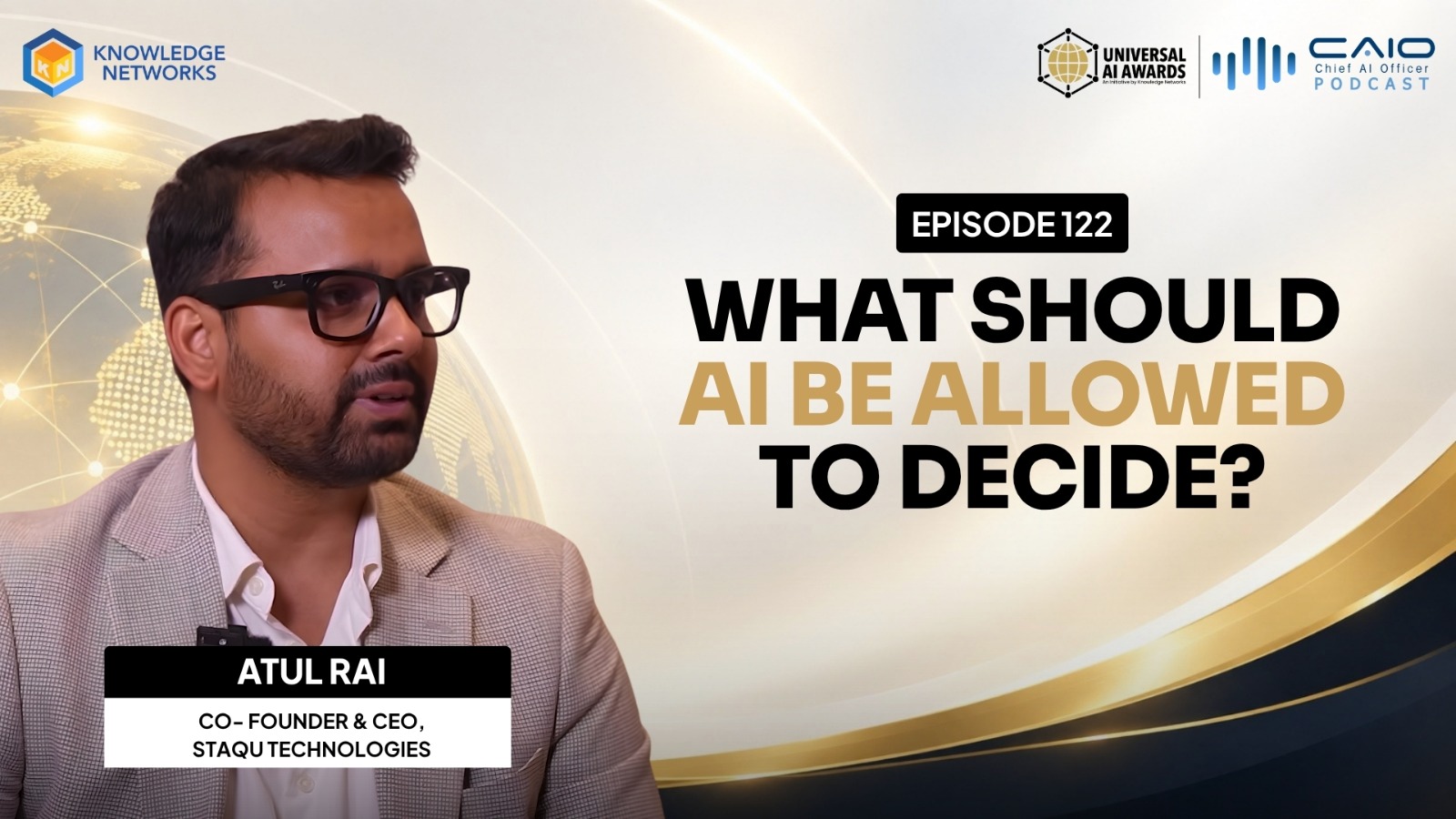
How much decision-making should we actually entrust to AI?
In this episode of the Regulating AI Podcast, recorded live at the Universal AI Awards launch in Delhi, Sanjay Puri speaks with Atul Rai, Co-founder & CEO of Staqu Technologies, about AI governance, accountability, security, AI models and the challenges of deploying artificial intelligence in mission-critical environments.
The conversation explores why AI governance cannot be an afterthought. As organizations deploy AI across sensitive areas, questions around data security, access, accountability, cost, reliability and human oversight become increasingly important.
Atul Rai discusses why the future of AI may not simply be about building larger and more powerful models, but about creating more efficient and optimized systems that can deliver meaningful outcomes while managing cost and complexity.
The conversation also looks at the use of AI in areas such as homeland security, public safety and crime detection. AI can identify patterns across enormous amounts of data and video that may be difficult for humans to process, but the question remains: when AI makes a prediction or recommendation, who should ultimately make the decision?
The discussion examines the limitations of current AI systems, including hallucinations, unpredictability and their difficulty in understanding consequences beyond the data they have been trained on.
Looking ahead, Atul Rai argues that the next generation of AI needs to go beyond prediction and move toward understanding consequences, while keeping human intention, ethics and accountability at the centre.
The episode ultimately asks a critical question for the AI era: If AI becomes increasingly powerful, how do we ensure that humans remain responsible for how that power is used?
Chapters:
00:00 – Why the future of AI isn’t just about bigger models
00:17 – Live from the Universal AI Awards in Delhi
01:03 – The risks of deploying AI faster than governance
01:30 – The real cost and ROI of implementing AI
01:54 – What happens when AI gets it wrong?
02:30 – AI decision-making and real-world consequences
02:46 – The growing challenge of AI data security
03:18 – Should AI information have different levels of access?
04:15 – How to choose AI use cases responsibly
04:32 – AI, homeland security and public safety
04:56 – Why human oversight matters in AI
05:28 – The challenge of AI costs and margins
05:59 – Why optimized AI models may matter more than bigger models
06:39 – Why AI governance requires a holistic approach
07:20 – Understanding the capabilities and limitations of AI
08:13 – Where should humans draw the line?
08:30 – How AI can connect patterns across crime data
09:21 – Why AI decisions need human monitoring
10:00 – Why today’s AI models still make mistakes
10:42 – What should we get right about AI today?
11:00 – Why today’s LLMs aren’t truly intelligent
11:40 – What should the AI of the future be able to predict?
12:20 – Bridging deterministic AI with a non-deterministic world
13:10 – The butterfly effect and AI’s limitations
13:33 – Can AI predict the next pandemic?
14:06 – Is AI good or bad? The role of human intention
14:14 – The responsibility behind AI’s power
14:36 – AI, medicine and solving difficult problems
14:44 – Closing thoughts
Guest: Atul Rai, Co-founder & CEO, Staqu Technologies
Host: Sanjay Puri
Podcast: Regulating AI
Recorded live: Universal AI Awards Launch, New Delhi
#AIGovernance #ArtificialIntelligence #ResponsibleAI #AIAccountability #AISecurity #AIRegulation #AIModels #HumanOversight #ComputerVision #FutureOfAI #AIIndia #StaquTechnologies #AtulRai #RegulatingAI #SanjayPuri

About the Author: Author
Chief AI Officer at AmeritasLeading enterprise AI strategy and technology integration. Advises Fortune 500 boards on high-value generative AI deployment architectures and governance frameworks.